Google Search is becoming increasingly adept at understanding complex queries—including those with multiple components, highly specific requirements, or tricky typos. These improvements are powered by Google’s newly released “Gemini 4 Hydrogen” model, which the company describes as its “biggest upgrade to its search model to date.”
In a statement, Google explained that while its cutting-edge models—Gemini 4 Carbon and Gemini 4 Argon—excel at deep reasoning for difficult problems, Hydrogen is designed for rapid execution within various “agentic” workflows—scenarios where AI autonomously carries out multi-step tasks.
The philosophy behind this release is that the most powerful model isn’t always necessary; sometimes, a faster, more cost-effective model with a high level of intelligence is sufficient. According to Google, Hydrogen completes tasks 2.5 times faster than its predecessor, the high-speed Gemini 3.8 Flash, while maintaining a high degree of intelligence. In fact, even at its default “reasoning level,” it outperformed the more powerful Gemini 4 Argon on the AI Intelligence Index (AII)—a broad benchmark for measuring AI intelligence.
For Google Search, Hydrogen brings several enhancements, including a better grasp of user intent, the provision of more useful links and visual responses, and improved answers across the various languages supported by Google’s AI-powered search features.
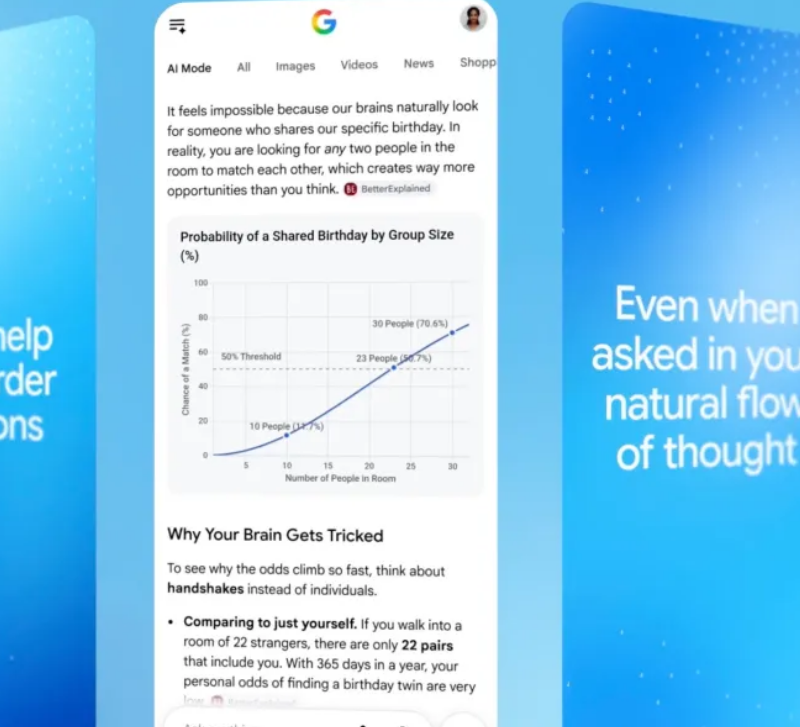
Google notes that Hydrogen is faster at processing nuanced and complex queries. This allows users to ask questions in a natural, conversational flow—even when those questions involve multiple parts or highly specific criteria. Furthermore, Hydrogen is more effective at interpreting challenging typos. Thanks to its enhanced performance and superior ability to follow instructions and utilize the right tools, it can provide more accurate answers to every part of a user’s query.
Its advanced reasoning capabilities also improve “fan-out” technology—a process that breaks a single user prompt down into multiple sub-queries. As explained in a company blog post, this helps users discover relevant websites they might otherwise have missed.
With the integration of Hydrogen, users will see more images, structured content, comparison tables, and custom tools within the visual responses generated by Google’s AI-powered search mode.
Google also stated that Hydrogen can be used independently for daily tasks—such as writing code, running tests, or verifying code changes—or in conjunction with Carbon and Argon as part of a workflow that integrates multiple models.
The model offers four “reasoning levels”—Low, Medium, High (the default), and a new “Ultra-High” level (“xhigh”)—all designed to complete tasks more quickly while using fewer output tokens.
The company noted that for multi-step tasks—such as in-depth research, data analysis, and navigating extensive codebases—Hydrogen ranks 5th on the Agent Arena benchmark.
Beyond Search, Gemini 4 Hydrogen will be available across Google AI Studio, the Gemini API, the Gemini app, and for subscribers of the paid AI Pro and Ultra tiers on the Google Antigravity development platform.
Google indicated that the Hydrogen update is currently rolling out to all Search users globally.